
Static Electricity: An Invisible Danger鈥擨ts Origins, Risks, and Mitigation
I. Where Does Static Electricity Come From?
3 Major Sources in Electronics Manufacturing
At its core, static electricity arises when different materials come into contact, undergo friction, and then separate—causing electric charges to transfer, accumulate, and fail to dissipate quickly. Dry conditions, insulating materials, and human activity are the three primary catalysts.
1. Human-Generated Static (The #1 Source)
- Activities such as walking, sitting, handling materials, or the friction between synthetic/common clothing fabrics generate static.
- Voltages can easily reach 1,000V–10,000V—far exceeding the tolerance levels of sensitive electronic components.
- While humans typically only perceive static at around 3,000V, some CMOS chips can suffer breakdown at voltages as low as 25V.
2. Static from Materials and Packaging
- Contact and separation involving PCBs, films, adhesive tapes, plastic trays, or shielding bags generate static.
- Processes like conveyor transport, handling of rolled materials, and the opening of packaging continuously produce static charges.
- Static attracts dust, which compromises insulation and reduces the reliability of soldering.
3. Static from Equipment and the Environment
- Ungrounded metal equipment, airflow from fans, and dry air (static levels spike sharply when humidity drops below 40%) are key factors.
- Induction: When a charged object approaches a conductor, electric charges rapidly accumulate on the conductor's surface.
In short: Wherever there is friction, separation, dry conditions, or insulating materials, static electricity is present throughout the entire production process.
II. How Dangerous Is Static Electricity? 3 Critical Risks in Electronics Manufacturing
Static electricity is more than just a minor "shock"—it directly impacts production yields, costs, and operational safety.
1. Hard Breakdown/Soft Failure of Components (Most Common)
1. Hard Breakdown/Soft Failure of Components (Most Common)
- Hard Breakdown: Instant burnout, short circuits, or open circuits—resulting in total component failure.
- Soft Damage: Undetectable to the naked eye; leads to system freezes, unexpected reboots, or significantly shortened lifespans after installation, often triggering large-scale after-sales returns.
- Industry Data: Electrostatic Discharge (ESD) is the leading cause of "hidden" (latent) failures in electronics manufacturing.
2. Cascading Production and Quality Issues
- Attraction of dust and debris, leading to poor soldering or functional anomalies.
- Interference with automated equipment, sensors, and testing instruments, causing operational errors or inaccurate data.
- Increased costs due to batch rework, customer complaints, and product scrapping.
3. Safety Risks
- In environments containing solvents, dust, or combustible gases, a static spark can trigger fires or explosions.
- Electric shocks to personnel can cause sudden involuntary movements or operational errors, potentially leading to secondary mechanical injuries.
For electronics manufacturers, ESD protection is not merely an option—it is a critical safeguard for survival.
III. How to Eliminate Static Electricity?
A comprehensive approach covering Personnel, Machines, Materials, Methods, and Environment.
Follow three core principles: Minimize generation, ensure rapid grounding, and actively neutralize charges—a practical, actionable strategy. 1. Personnel Protection (Most Critical)
- Mandatory Attire: Anti-static garments, footwear, and gloves/finger cots; synthetic fibers are strictly prohibited.
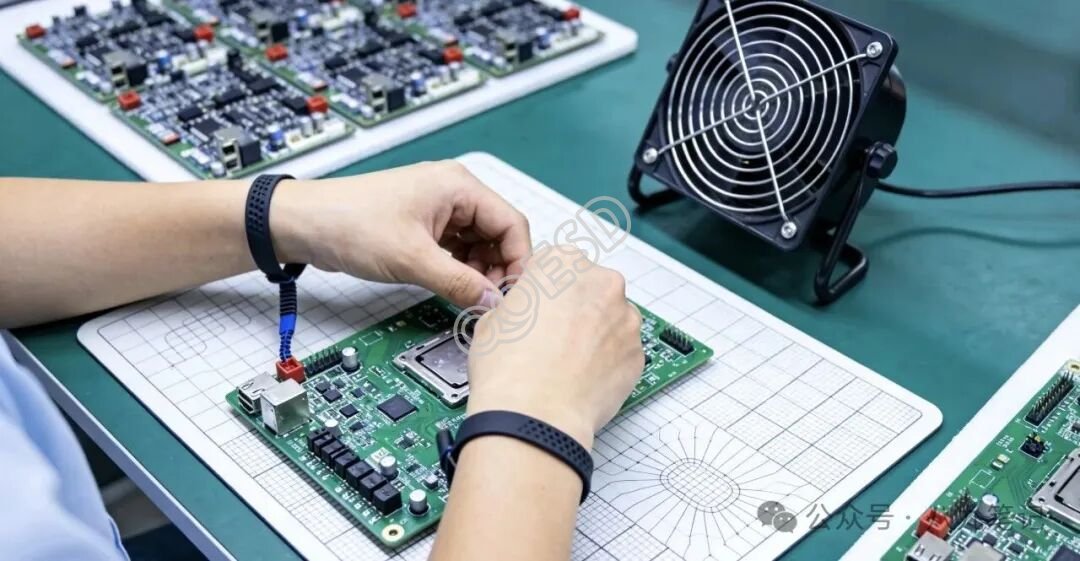
- Mandatory Equipment: Anti-static wrist straps (must be in direct contact with skin, tested daily, and reliably grounded).
- Mandatory Procedure: Discharge static electricity before starting work by touching a grounded metal object or passing through an ESD test gate.
- Prohibitions: Handing sensitive components directly between individuals; touching component pins or solder pads; wearing metal jewelry.
2. Equipment and Grounding (Fundamental Baseline)
- All workstations, assembly lines, soldering irons, shelving units, and tools must be reliably grounded.
- Grounding Resistance: ≤4Ω for precision areas; ≤10Ω for general areas. Regular inspections are required.
- Work surfaces must be covered with anti-static mats; floors must be equipped with anti-static flooring that is properly grounded.
3. Environmental Control (Most Cost-Effective)
- Relative humidity: 45%–60% RH; mandatory humidification during dry seasons.
- Temperature: 22±2°C to minimize static accumulation and discharge.
- Record data every 2 hours; initiate emergency protocols if humidity falls below 35%.
4. Materials and Packaging (End-to-End Isolation)
- Use anti-static trays, shielding bags, or conductive totes for sensitive components.
- Prohibited: Wrapping items directly in standard plastic bags, bubble wrap, or regular adhesive tape.
- All items entering or leaving an ESD Protected Area (EPA) must be in anti-static packaging; never place components directly on non-ESD-safe surfaces.
5. Active Neutralization (Advanced Protection)
- Equip high-sensitivity workstations with ionizers (fans or air guns) to rapidly neutralize electrical charges.
- Install static elimination bars and monitoring/alarm systems on assembly lines.
- Implement zoned management for ESD Protected Areas (EPAs) in critical work areas.
6. Management and Training (Long-Term Assurance)
- Mandatory ESD training and assessment for all new employees before they begin work.
- Daily inspections of wrist straps, footwear, garments, grounding systems, and environmental conditions (temperature/humidity). Establish a failure analysis mechanism and incorporate ESD (Electrostatic Discharge) into quality KPIs.
IV. Keep these 5 points in mind for stable ESD control on the production floor:
1. Humidify in dry conditions—humidity is the most cost-effective form of ESD protection.
2. Ensure everyone wears a wrist strap and ESD-safe clothing; if it’s not in direct contact with the skin, it’s effectively useless.
3. All metal objects must be grounded; verify resistance levels periodically.
4. Never handle sensitive components with bare hands, leave them exposed, or use standard (non-ESD) packaging.
5. No ESD issue is trivial; latent (hidden) failures are the most costly.